

 jennie
 Kombucha is a fermented tea beverage produced by adding a symbiotic culture of bacteria and yeast (SCOBY) to sweetened tea, creating a tangy, slightly effervescent drink through the process of fermentation. This ancient elixir shares more DNA with your homebrew than you might think, both relying on controlled fermentation to transform simple ingredients into complex, living beverages.
The origin story of kombucha reads like a brewing mystery wrapped in folklore. Most evidence points to China as the birthplace, though pinning down an exact timeline proves remarkably difficult. Some sources suggest kombucha could be as old as 5,000 years, while others place its emergence closer to 200 years ago. What we know with greater certainty is that by the early 20th century, kombucha had migrated from China to Russia, then spread across Eastern Europe and Germany, carried along trade routes and passed between households like a prized sourdough starter.
Here’s where things get interesting for brewers: the name “kombucha” itself adds another layer of confusion. The term derives from the Japanese word for kelp tea, yet the fermented tea drink we know today has absolutely nothing to do with seaweed. This etymological quirk highlights just how murky kombucha’s documented history really is.
For Colorado homebrewers accustomed to precise recipes and reproducible results, kombucha’s uncertain origins might seem frustrating. But that ambiguity also speaks to its grassroots, community-driven nature. This article traces kombucha’s geographic journey, explains the fermentation mechanics that transform sweet tea into a probiotic powerhouse, and explores how this traditional brew has evolved into the commercial phenomenon now sitting alongside craft beer on taproom menus across the state.
What Kombucha Actually Is
Kombucha is a fermented tea beverage made by combining sweetened black or green tea with a SCOBY, a symbiotic culture of bacteria and yeast. This living culture transforms the tea over one to three weeks, producing a tangy, slightly effervescent drink with a characteristic sour bite and subtle sweetness. The result is a probiotic-rich beverage that’s both refreshing and functional, containing beneficial bacteria similar to what you’d find in yogurt or sauerkraut.
- SCOBY
- A symbiotic culture of bacteria and yeast that forms a rubbery, pancake-like disc on the surface of fermenting tea. This living organism is responsible for converting sweet tea into kombucha.
- Symbiotic culture
- A cooperative community where bacteria and yeast work together, each providing benefits the other needs to thrive. In kombucha, this partnership creates the drink’s unique flavor and probiotic profile.
- Fermentation
- The metabolic process where microorganisms convert sugars into acids, gases, or alcohol. In kombucha, fermentation produces organic acids, trace alcohol, and carbonation.
- Probiotic
- Live beneficial bacteria that support digestive health and gut function. Kombucha’s fermentation process creates various probiotic strains, though exact counts vary by batch.
For brewers, kombucha shares fundamental principles with beer production. Both rely on living cultures to transform simple ingredients, sugars in tea for kombucha, starches in grain for beer. Both demand attention to temperature, pH, and time. The key difference is the type of culture: where beer uses single-strain yeast, kombucha employs a complex community of bacteria and yeast working in concert. This makes kombucha fermentation less predictable but also more forgiving than brewing beer.
Understanding where kombucha comes from matters because it connects us to fermentation traditions that predate modern brewing science. Like appreciating a Belgian lambic’s spontaneous fermentation history or a German lager’s lagering evolution, knowing kombucha’s roots deepens respect for the craft and the living cultures that make it possible.
Tracing Kombucha’s Geographic Origins

The China Connection
China holds the strongest claim as kombucha’s birthplace, but the trail grows faint remarkably fast. Most fermentation historians point to northeastern China during the Qin or Han dynasties, roughly 220 BCE to 220 CE, as a plausible timeframe. That said, no surviving texts from that era describe kombucha specifically, what we have instead are references to fermented teas and medicinal brews that might have been ancestral versions.
The challenge is that ancient Chinese fermentation culture was already sophisticated by then, with multiple tea-based tonics documented for health purposes. Pinning down which one evolved into modern kombucha requires connecting dots across centuries of oral tradition and sparse written records. Some scholars suggest kombucha emerged as a folk remedy among tea-growing regions, valued for digestive benefits much like other fermented foods in Chinese medicine. Others theorize it spread along trade routes from Manchuria, where cooler climates suited the slow fermentation SCOBY prefers.
What’s frustrating for anyone chasing certainty: the oldest verifiable references to kombucha-like drinks appear in Russian and German sources from the early 1900s, not Chinese ones. That doesn’t disprove Chinese origins, it just means the paper trail starts later than the practice itself, leaving us with educated guesses rather than hard proof.
The Journey West
By the early 20th century, kombucha had moved well beyond China’s borders, carried westward along trade routes that linked Asia to Europe. Russia became the drink’s first major stop outside East Asia, likely introduced through merchants and travelers moving across the Trans-Siberian corridor. By the 1910s and 1920s, kombucha had taken root in Russian households, where it was brewed in kitchens and shared among communities as a home remedy and refreshing drink.
From Russia, the fermented tea spread into Eastern Europe and Germany, regions already familiar with fermentation through beer, kvass, and pickled foods. This cultural fluency with living-culture beverages helped kombucha find a receptive audience. The SCOBY, often called a “tea mushroom” in European languages, passed from neighbor to neighbor, propagating the tradition through personal exchange rather than commercial channels.
This person-to-person transmission mirrors how brewing knowledge has always traveled: through sharing starter cultures, recipes, and techniques across borders. The kombucha that reached Europe wasn’t standardized or branded, it was a living craft, adapted to local tastes and ingredients, evolving as it moved.
Why It’s Called ‘Kombucha’
The name “kombucha” presents one of the drink’s most confusing puzzles. The word itself is named after Japanese kelp tea“kombu” refers to kelp, and “cha” means tea in Japanese. Yet kombucha, the fermented drink, contains no kelp whatsoever and has virtually nothing to do with traditional Japanese kombu tea, a savory seaweed broth.
How did this happen? The most widely accepted theory involves a classic case of mistaken identity. When kombucha traveled from Russia to Japan in the early 1900s, it likely got mixed up with an existing Japanese beverage already called kombucha. The fermented tea inherited the name through confusion rather than any actual connection. Another theory suggests the name arose from garbled translations during kombucha’s westward journey, with the word sticking despite its irrelevance.
Brewers will recognize this phenomenon, beer naming rarely follows logic either. India Pale Ale evolved in England, not India, named for its destination rather than birthplace. Russian Imperial Stout was brewed in London for export. Berliner Weisse now thrives in American craft breweries far from Berlin. Names capture moments in a beverage’s journey, not necessarily its essence.
The kombucha naming mystery underscores how much we don’t actually know about this drink’s history. If we can’t even pin down why it’s called what it’s called, pinpointing its precise geographic or temporal origin becomes even trickier. The name stuck because beverages travel through cultures messily, picking up labels that make sense in context but puzzle later generations. For a drink supposedly thousands of years old, kombucha carries remarkably modern confusion in its very identity.
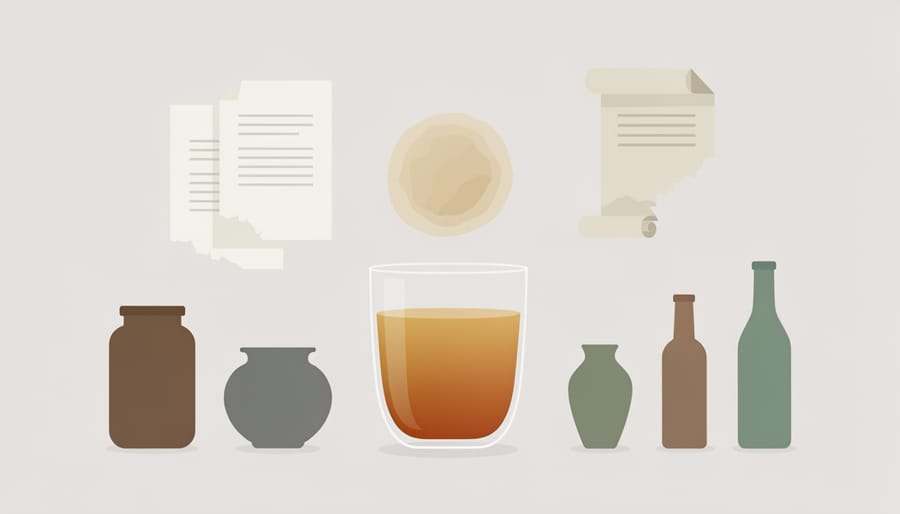
How Kombucha Fermentation Works
At its core, kombucha fermentation operates on the same fundamental principle as brewing beer: living microorganisms transform sugars into something entirely new. The process starts with sweetened tea, typically black or green tea, though other varieties work, and a thick, rubbery mat called a SCOBY. That stands for symbiotic culture of bacteria and yeast, and it’s the engine driving everything that happens next.
The SCOBY houses a complex community where bacteria and yeast work in tandem. The yeast strains break down the tea’s sugars (usually plain white sugar) into simpler compounds and produce alcohol as a byproduct. Meanwhile, acetic acid bacteria consume that alcohol and convert it into acetic acid, the compound responsible for kombucha’s signature tang. Other bacterial strains contribute gluconic acid and trace amounts of lactic acid, building layers of complexity similar to what you’d find in brewing sour beer.
The first fermentation typically runs seven to fourteen days at room temperature, around 68 to 78 degrees Fahrenheit. Temperature control matters here just as it does in your fermentation chamber, too cold and the culture slows to a crawl, too hot and off-flavors develop or the balance tips toward excessive vinegar character. During this stage, the SCOBY floats or sinks (both are normal), gradually consuming the sugar and shifting the liquid from sweet tea into tart, slightly fizzy kombucha. You’ll notice a new SCOBY layer forming on the surface, a visual confirmation that fermentation is active.
The second fermentation happens after you remove the SCOBY and bottle the liquid. This stage mirrors bottle conditioning in beer: residual sugars and any added fruit or flavorings feed the remaining yeast, producing carbon dioxide trapped in sealed bottles. A few days at room temperature builds that characteristic effervescence. The longer you let it go, the drier and fizzier it becomes.
The transformation is dramatic. What starts as sweet tea ends up tangy, lightly carbonated, and alive with beneficial bacteria, a testament to how simple ingredients, living cultures, and controlled time create something far greater than the sum of their parts.
Different Styles and Regional Variations

Kombucha’s evolution mirrors beer’s journey from ancient staple to craft innovation, with styles varying dramatically by region and era. Traditional unflavored kombucha remains closest to its Chinese roots: a straightforward fermentation of black or green tea with sugar, producing a clean, acidic beverage with minimal fizz. This base version showcases the SCOBY’s work without distraction, much like appreciating a simple pale ale reveals the fundamental yeast role in brewing.
Russian tea kvass traditions introduced a darker, earthier profile using black tea and longer fermentation times, creating robust flavors that suited the colder climate. Chinese methods traditionally emphasized green tea bases and shorter ferments, yielding lighter, more delicate brews. These regional preferences developed independently, shaped by available ingredients and local taste, similar to how Belgian brewers favored wild fermentation while German traditions emphasized precise lager techniques.
Modern American craft kombucha has exploded into countless variations:
- Traditional unflavored versions honoring ancient methods
- Fruit-infused styles with mango, berry, and citrus additions
- Herb and spice blends incorporating ginger, lavender, or hibiscus
- Jun kombucha made with honey instead of sugar and green tea
- Hard kombucha with higher alcohol content through extended fermentation
- Hybrid beer-kombucha experiments blending brewing techniques
Colorado’s craft beverage scene has embraced kombucha as a natural taproom companion. Local breweries now offer kombucha taps alongside their beer lines, attracting health-conscious customers and designated drivers without sacrificing the craft beverage experience. Some brewers experiment with hybrid ferments that combine hop-forward kombucha or kombucha-soured ales, applying their knowledge of carbonating your beer to achieve controlled effervescence in kombucha. These innovations demonstrate how understanding one fermentation tradition enriches another, creating new categories that respect both ancient origins and modern palates.
How Kombucha Is Used Today
Kombucha has evolved far beyond its origins as a home-fermented curiosity. Today, it occupies a prominent spot in health-focused markets, craft beverage lineups, and even culinary experiments that would surprise its ancient practitioners.
The health and wellness community has embraced kombucha for its probiotic content and potential digestive benefits. Fitness enthusiasts reach for it as a low-sugar alternative to sodas, while others appreciate the naturally occurring B vitamins and organic acids produced during fermentation. Whether these benefits match the hype remains debated, but the demand keeps growing.
Bartenders and mixologists have discovered kombucha’s versatility in cocktail and mocktail culture. Its bright acidity and natural effervescence add complexity to drinks without the flatness of juice or the sweetness of soda. A ginger kombucha can anchor a Moscow Mule variation, while fruit-forward versions bring dimension to spritzers and shrubs. For Colorado brewers familiar with balancing hop bitterness and malt sweetness, kombucha’s tangy profile offers a parallel challenge in adding flavors to mixed drinks.
In the kitchen, kombucha functions as a live-culture ingredient. Chefs use it in marinades where its acidity tenderizes meat, much like buttermilk or vinegar but with added complexity. Salad dressings gain brightness from kombucha, and adventurous bakers experiment with it in sourdough starters.
For the craft beverage world, kombucha represents genuine crossover territory. Breweries across Colorado and beyond now install dedicated kombucha taps, applying their fermentation expertise to a non-alcoholic product. The skills transfer remarkably well: SCOBY management mirrors yeast handling, pH monitoring parallels mash chemistry, and temperature control remains critical. Some brewers push further, incorporating kombucha into mixed fermentation projects or using the acidified tea as a souring agent. It’s fermentation knowledge applied to new canvas.
Common Questions About Kombucha’s Origins
Where did kombucha come from?
Kombucha is believed to have originated in China, though the exact location and circumstances remain uncertain. By the early 20th century, the drink had spread to Russia, then moved westward into Eastern Europe and Germany through trade routes and cultural exchange.
How old is kombucha?
The age of kombucha is one of its greatest mysteries. Estimates range wildly from as ancient as 5,000 years to as recent as 200 years, depending on which historical accounts you trust and how you define the drink itself.
Why is kombucha called kombucha?
The name comes from the Japanese term for kelp tea, yet the fermented tea drink has absolutely no connection to kelp or traditional Japanese kombu tea. This linguistic mix-up has stuck, though no one knows exactly how or why the misnomer became standard.
What makes kombucha’s origin so hard to pin down?
Several factors obscure kombucha’s true birthplace: fermentation practices existed independently across multiple cultures, written records are sparse or lost, and oral traditions vary widely. The nature of fermentation kombucha itself means similar drinks could have developed in parallel without a single point of origin.
These questions reflect what most people wonder when they first encounter kombucha’s backstory. The honest answer to nearly all of them involves acknowledging uncertainty rather than spinning a tidy origin myth. For brewers familiar with beer’s own tangled history, where styles evolved across regions and naming conventions don’t always track lineage, kombucha’s murky past feels familiar. Both traditions remind us that fermentation knowledge spread through doing and sharing, not always through documentation.
The truth is, we may never know exactly where or when kombucha first bubbled to life. That uncertainty isn’t a flaw in the story, it’s part of what makes this fermented tea so compelling. While we can trace its documented journey from China to Russia and beyond, the gaps in the record connect us to something deeper: thousands of years of humans nurturing living cultures, passing knowledge through practice rather than pages.
For Colorado brewers and beer enthusiasts, kombucha offers a natural extension of the skills you already love. The same respect for temperature, timing, and microbial balance that produces great beer applies to guiding a SCOBY through fermentation. The same patience that rewards a well-conditioned ale brings complexity to a second-fermented kombucha. Many local taprooms already recognize this kinship, adding kombucha taps alongside their beer lines and experimenting with hybrid ferments that blur the boundaries between ancient and modern craft.
Whether you’re a homebrewer looking to expand your repertoire or a beer lover curious about flavor frontiers beyond hops and malt, kombucha invites exploration. Its murky origins mirror the experimental spirit at the heart of all fermentation, try something, observe what happens, adjust, and try again. You’re not just making a trendy beverage. You’re participating in a living tradition that has survived precisely because passionate people kept experimenting, one batch at a time.